

FG Announces Surge In Crude Output, Deepens Reforms To Attract Global Investment
The Federal Government has touted a significant rebound in Nigeria’s oil sector, announcing that crude production has climbed from about 1.0 million barrels per day (bpd) in 2023 to over 1.8 million bpd today — a marker of renewed investor confidence and the early success of ongoing reforms.
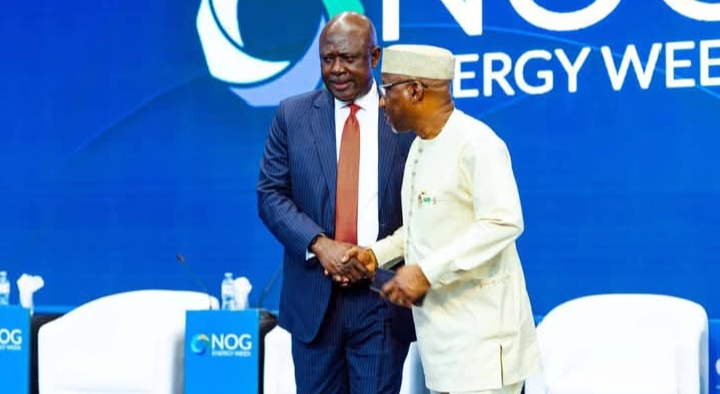
Ministers of State for Petroleum Resources (Oil) and (Gas), Senator Heineken Lokpobiri and Rt. Hon. Ekperikpe Ekpo, made the disclosure at the opening of the 25th Nigeria Oil and Gas (NOG) Energy Week 2026 in Abuja, saying bold policy measures, clearer regulation and strategic investment have driven the turnaround.
“We have reversed years of decline,” Senator Lokpobiri said, noting that active drilling rigs have increased from 14 to more than 60 as exploration and production activity accelerates. He said the government is committed to further raising output through sustained investment, improved security, regulatory stability and deeper industry collaboration.
Rising global demand for Nigerian crude, the minister added, underscores the need to expand production capacity. He credited the Petroleum Industry Act (PIA), the administration’s reforms and decisive resolution of longstanding sectoral challenges for the renewed momentum.
Lokpobiri highlighted shifting industry dynamics: divestments by IOCs such as Shell, ExxonMobil and ENI have opened space for indigenous players, who now produce over 60% of Nigeria’s daily crude. He said IOCs are concentrating on deep offshore projects, offering fresh prospects for reserve growth and higher future output.
To ease the cost of doing business, the minister said the Nigerian Upstream Petroleum Regulatory Commission (NUPRC), working with the Independent Petroleum Producers Group (IPPG), has commissioned PricewaterhouseCoopers (PwC) to benchmark and simplify the sector’s multiple taxes, levies and statutory charges.

On gas, Rt. Hon. Ekperikpe Ekpo reiterated plans to harness Nigeria’s more than 215 trillion cubic feet of proven gas reserves under the Decade of Gas Initiative, while noting that the PIA and presidential executive orders have attracted fresh investment and improved contracting and fiscal certainty across the gas value chain.
Ekpo referenced major infrastructure developments — including the Ajaokuta-Kaduna-Kano (AKK) pipeline, OB3 pipeline expansions and NLNG Train 7 — that will expand gas processing and LNG capacity from 22 to 30 million tonnes per annum.
He also cited domestic initiatives such as the Presidential CNG programme and the National Clean Cooking Programme to grow local gas utilisation.
Special Adviser to the President on Energy, Mrs. Olu Verheijen, reiterated the administration’s production targets of 3 million bpd of crude and 10 billion standard cubic feet of gas per day by 2030.
She said recent reforms have helped secure over USD 10 billion in upstream Final Investment Decisions (FIDs) in the past three years, raised crude and condensate output by more than 400,000 bpd, and returned onshore production to its strongest level in nearly two decades.
Mrs. Verheijen added that Nigeria’s improving investment profile is reflected in a rise in upstream FIDs and external reserves surpassing USD 50 billion, signals the government views as evidence that reforms are restoring the country’s position as a leading destination for upstream investment in Africa.