

Maritime Disputes Must Be Resolved Swiftly To Attract Investors – FG
...Maritime Disputes Should Be Resolved in Nigeria Courts – Oyetola
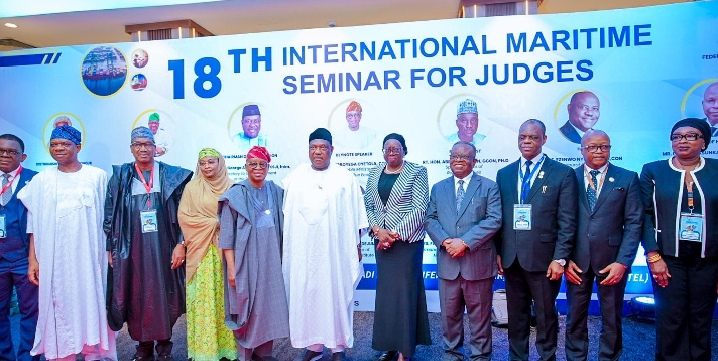
The Federal Government has stressed that the swift and efficient resolution of maritime disputes is critical to attracting investment, boosting trade and positioning Nigeria as a preferred maritime hub in Africa.
Speaking at the opening of the 18th International Maritime Seminar for Judges in Abuja, the Secretary to the Government of the Federation (SGF), Senator George Akume, said a credible and efficient maritime justice system is indispensable to Nigeria’s economic development and the success of the government’s Renewed Hope Agenda.
He noted that investors and international shipping companies would only commit capital to Nigeria’s maritime sector if they were confident that commercial disputes would be resolved fairly, promptly and professionally.
“A credible, efficient and commercially aware maritime justice system is not merely favourable to that ambition; it is indispensable. No investor will commit capital to Nigeria’s maritime economy if they cannot trust that contractual disputes will be resolved fairly and swiftly,” he said.
Akume added that shipping lines would be reluctant to regard Nigeria as a reliable port of call if legal processes were slow, unpredictable or technically uninformed.
According to him, “No shipping line will regard Nigeria as a reliable port of call if they fear that legal processes will be slow, unpredictable or technically uninformed. This seminar addresses those concerns directly.”
The SGF described maritime justice as a national economic issue rather than a sector-specific concern, stressing that delays in resolving maritime claims undermine investor confidence, increase the cost of doing business and ultimately affect the prices of goods and services across the country.
“When a maritime claim is delayed in court, investor confidence falls. When commercial disputes go unresolved, the cost of imports, exports and essential goods rises. These are not merely legal abstractions; they are economic realities,” he said.
He commended the Nigerian Shippers’ Council for sustaining the International Maritime Seminar for Judges since its inception in 1995, describing it as one of Africa’s foremost judicial capacity-building programmes.
Akume also praised the collaboration between the Nigerian Shippers’ Council, the National Judicial Institute and the Nigerian Maritime Law Association, saying the partnership had strengthened the capacity of judicial officers handling maritime matters.
He reaffirmed the Federal Government’s commitment to implementing actionable recommendations from the seminar, including legislative reforms, ratification of international conventions and improved coordination among relevant government agencies.
“We will actively support the follow-through of actionable recommendations that emerge from this seminar. Where resolutions call for legislative review, we will engage the appropriate channels within the National Assembly and the Federal Ministry of Justice. Where they require ratification of international conventions, we will ensure the relevant executive processes are pursued,” he said.
The SGF also urged key maritime agencies, including the Nigerian Maritime Administration and Safety Agency (NIMASA), the Nigerian Ports Authority (NPA), the Nigeria Customs Service and the Federal Ministry of Marine and Blue Economy, to strengthen collaboration in order to provide a predictable and efficient operating environment for global shipping and trade.
He expressed optimism that the seminar’s deliberations would translate into concrete policy, legislative and institutional reforms that would strengthen maritime justice, enhance Nigeria’s competitiveness and support the country’s aspiration to become a leading maritime nation in Africa.
Also speaking, the Minister of Marine and Blue Economy, Dr Adegboyega Oyetola, said Nigeria must strengthen its maritime justice system to ensure complex shipping disputes are resolved within the country rather than in foreign courts or arbitration centres.
Oyetola said a predictable, efficient and internationally respected judiciary is critical to Nigeria’s ambition of becoming Africa’s preferred maritime hub and unlocking the full potential of the blue economy.
He stressed that judicial excellence had become a strategic economic asset capable of attracting investment, reducing transaction costs and boosting confidence in Nigeria’s maritime sector.
“Nigeria cannot aspire to become Africa’s preferred maritime hub while complex shipping disputes continue to be routinely resolved in foreign jurisdictions through litigation or arbitration. The strengthening of our admiralty jurisprudence is therefore an essential pillar of our national economic strategy,” the minister said.

According to him, every judgment delivered in maritime matters sends a strong signal to investors, shipowners, insurers, financiers and other stakeholders across the global shipping industry.
“A predictable, well-reasoned, and internationally informed judiciary is itself an instrument of economic competitiveness. It lowers transaction costs, enhances commercial confidence, encourages parties to choose Nigerian courts and Nigerian arbitration centres for the resolution of maritime disputes, and reinforces Nigeria’s reputation as a credible destination for maritime investment,” he said.
Oyetola noted that while the Federal Government had made significant investments in maritime infrastructure and policy reforms, including the development of the National Policy on Marine and Blue Economy, port modernisation and the Deep Blue Project, the success of these initiatives ultimately depends on a judiciary that inspires confidence.
He said, “Infrastructure, policy reforms, and institutional development alone cannot guarantee the success of our maritime aspirations. They must be complemented by a legal and judicial system that commands confidence both nationally and internationally.”
The minister disclosed that the administration had secured a £746 million financing agreement with the United Kingdom for the modernisation of Apapa and Tin Can Island ports, approved the disbursement of the Cabotage Vessel Financing Fund (CVFF), restored Nigeria to Category C of the International Maritime Organization (IMO) Council and increased revenue generated by maritime agencies to over ₦1.8 trillion in 2025.
He also highlighted improvements in maritime security, saying Nigeria had remained piracy-free within its territorial waters for four consecutive years through the Deep Blue Project.
Oyetola urged judges to continuously update their knowledge to address emerging legal issues arising from technological innovations, digital shipping, environmental regulations and maritime security.
He pointed to developments such as Maritime Autonomous Surface Ships, blockchain-enabled cargo documentation, electronic bills of lading and decarbonisation as areas that would increasingly generate complex legal disputes.
“The maritime legal landscape is undergoing profound transformation globally, and Nigeria must not be left behind. It is therefore imperative that our judicial officers continue to update their knowledge and remain abreast of emerging developments in maritime law,” he said.
The minister reaffirmed the Federal Government’s commitment to strengthening Nigeria’s maritime legal framework through specialised maritime divisions of the Federal High Court, alignment of domestic laws with international conventions, enhanced collaboration between maritime agencies and the judiciary, and greater support for maritime arbitration.
“We shall continue to support the expansion of specialised maritime divisions within the Federal High Court, staffed by appropriately trained judicial personnel. We will also encourage the development of robust alternative dispute resolution mechanisms, particularly maritime arbitration, to complement judicial processes while providing commercially efficient pathways for dispute settlement,” he added.
The seminar, organised by the Nigerian Shippers’ Council in collaboration with the National Judicial Institute, brought together judges, arbitrators, maritime law practitioners, regulators and stakeholders from Nigeria and other West African countries to discuss emerging issues in maritime law and strengthen judicial capacity in the sector.
Also speaking, the Chief Justice of Nigeria, Justice Kudirat Kekere-Ekun, who declared the seminar open, said the maritime sector serves as a vital channel for the movement of goods and services, facilitates international trade, supports economic growth and contributes significantly to employment and national revenue.
The Chief Justice further emphasised the importance of effective and prompt dispensation of admiralty justice, noting that maritime disputes often involve complex, time-sensitive and cross-border transactions.
She stressed that delays in resolving such disputes could disrupt commercial operations, increase costs, undermine investor confidence and affect the smooth functioning of the maritime industry. She therefore underscored the need for a responsive, efficient and specialised system of admiralty justice capable of resolving maritime disputes in a timely and effective manner.
Justice Kekere-Ekun also highlighted the importance of collaboration across jurisdictions, particularly given the inherently international nature of maritime commerce.
She noted that ships, cargoes, commercial transactions and maritime disputes frequently involve multiple countries and legal systems, making cooperation among courts, judicial officers, regulators, legal practitioners and other stakeholders essential.
She further underscored the importance of the seminar as a platform for judicial and professional engagement, knowledge-sharing and the strengthening of institutional capacity in the field of maritime law.