

AFTER FIVE MONTHS: ITF Rescues Ten Seafarers Over Ship Abandonment
ITF Rescues Ten Seafarers Over Ship Abandonment
Ten Syrian seafarers flew home from Cyprus, after five months stranded on an abandoned ship yesterday with all their wages after a union inspector battled to rescue them.
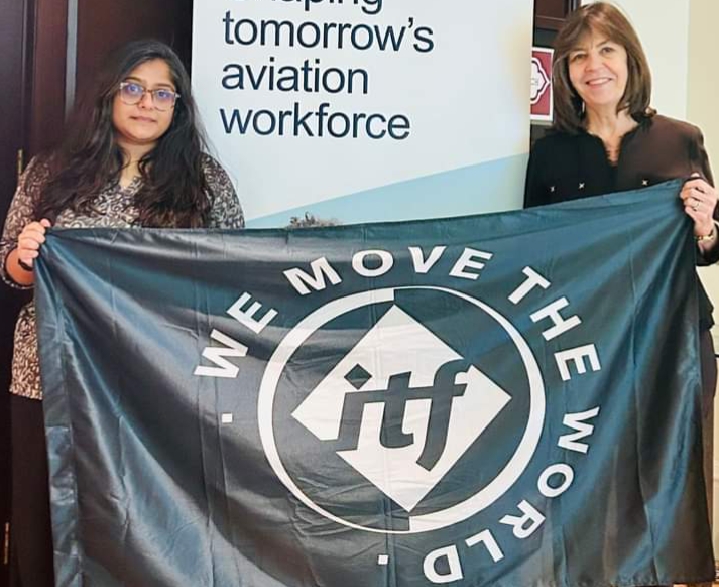
Christiana Efstratiou, the International Transport Workers Federation (ITF)’s Cypriot inspector, who qualified just 18 months ago, had earlier won the Syrian crew a pay increase to an acceptable wage level. Later when the ship was abandoned she was instrumental in getting the seafarers wages paid and repatriation arranged.
The court order to pay the seafarers was announced yesterday morning (8 October) just as the ITF General Secretary Stephen Cotton was telling the delegates at the Cyprus Maritime Conference that this year the number of abandoned crew increased to around 300.
That is “partly due to defining what abandonment is,” he said, adding, there is a need to find new ways to protect crew.
In the case of the Mar 4, a 1992 built, 3,700 dwt general cargo vessel owned by Mar Marine Shipping LLC and managed by Haykal Ship Management both of the same address in Istanbul, Turkey, Efstratiou had secured a pay increase for the underpaid Syrian crew, who Seatrade Maritime News is not naming for security reasons.
At the time the vessel was moored off Larnaca, Cyprus, before it sailed to Cyprus’ facility at Vassiliko. There it is understood to have damaged telecommunications cables and was duly arrested.
With the vessel no longer trading, the owner abandoned the Tanzanian-flagged ship, leaving the crew stranded on board without pay for five months. Letters to the Tanzanian registry proved fruitless, with no response to either the ITF or the Admiralty Marshall.
A court order allowed the ship to be auctioned and the income from its sale resulted in the payment and repatriation of the crew.
For Efstratiou the outcome was emotional: “The crew became like a family to me, so to see them touch dry land for the first time was the greatest feeling ever,” she said.
Meanwhile back at the conference Stephen Cotton was responding to a question from the floor on why modern digital technology is not being used to protect seafarers from abandonment, criminalisation, rogue crewing agents and other criminal activity.

Cotton responded by saying that the union, which is a federation of trade unions from many countries, were approached by major shipping company MSC on behalf of shipowners to look at drug trafficking in response to a particular example.
That led to the ITF, at the end of last year approaching the IMO Secretary General, Arsenio Dominguez, “who’s doing a marvellous job at the IMO,” to host a meeting of the International Chamber of Shipping, the ITF, ILO and the IMO on how to “educate governments to make sure they don’t penalise seafarers”.
In addition, Cotton said: “There is technology that can prove that a seafarer could not possibly have touched the fruit pallet or put something in a container.”
He referenced the Ally Albokhari case in Turkey, commenting, “You could say Turkey has not been great on this, they have penalised seafarers when it’s technically impossible for them to have put the drugs on board.”
Most recently Turkey arrested a further three seafarers after drugs were found on board a vessel they were serving on, with the ITF working with the P&I Club and Bimco, and the owners to represent the crew’s interest.
According to Cotton, the ITF recognises that the crew can at times be caught up in criminal activity, however, “We need to use technology, we need to use the controls on the gates of the containers.”
As a result, the ITF is revising its shipping inspection reports around the issues of seafarer safety, criminalisation and abandonment.
He said: “It’s on us to understand the technology in support of the shipowners who are ready to embrace these changes.”
Moreover, the ITF is, “Looking at how we can use AI to understand what are the problems of seafarers, we have 150 ITF inspectors around the world, at the moment it is somebody’s job to evaluate all the claims by seafarers, AI can make that much more efficient and safe tool, and then we can produce evidence to say these are the facts this is what’s happening and we can go to employers and say let’s do these things better.”
The Mar 4, case is a good example of the authorities and the union working together to protect the rights of seafarers.
But it is also an example of the effectiveness of collaboration between the various political, employer/industrial and working groups who working together can help to protect seafarers from the increasingly challenging world in which they work.
That work will be made more efficient with the use of technology: “So, for us definitely technology should be part of our armoury to protect seafarers,” concluded Cotton.
Comments are closed.