

By Roland Ekama
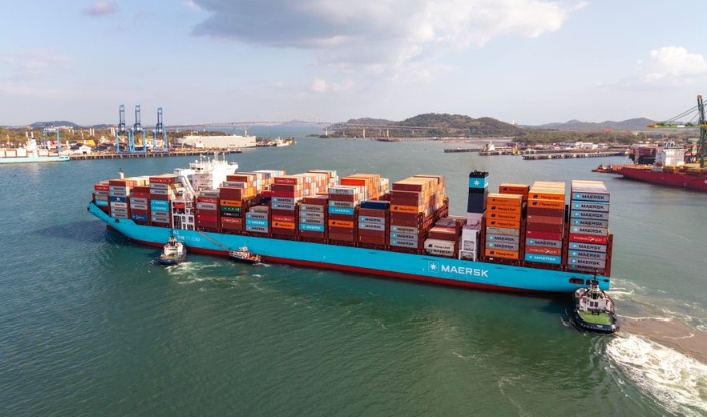
Maersk has introduced an additional fee of $1,000 per container for cargo on vessels transiting routes linked to the Strait of Hormuz, the shipping line said in its latest operational update on 23 July.
The surcharge is being added on top of existing emergency freight rates for many regional cargoes.
Although Maersk is not currently operating services directly through the Strait of Hormuz, the carrier said the new charge reflects elevated security and operational risks as ship transits through the waterway have fallen sharply in the past week.
The drop in transits follows repeated attacks on vessels attributed to Iran and a US blockade of Iranian ports.
As part of its response to the Middle East crisis, Maersk has been using landbridge routes between Red Sea ports and Gulf coast ports—routing containers via Suez and the Bab el-Mandeb Strait to connect Gulf states with external markets.

Those alternate corridors may face disruption after Houthi threats on 19 July to blockade Saudi ports and block Saudi-linked transits through Bab el-Mandeb; the Houthis said two Saudi tankers were attacked overnight on 23 July, though only one attack has been publicly confirmed by Saudi sources.
Maersk did not immediately say whether the new surcharge would be adjusted if the Houthi threats materialise or if additional security risks force further rerouting.
The surcharge comes after Maersk had only recently begun returning some services to the Red Sea following a period when major carriers re-routed around the Cape of Good Hope to avoid the Houthi threat off Yemen in late 2023. In its 40th Middle East Operational Update, Maersk listed a range of contingency measures adopted since the US and Israel attacked Iran on 29 February 2026, including multiple landbridge options linking Saudi Arabia, Kuwait, Bahrain, the UAE, Qatar and Iraq; however, landside bookings remain suspended on many routes.
Maersk also described movements of vessels out of the Arabian Gulf during calmer periods, noting that in late June the Maersk Baltimore and a time-chartered vessel left the Gulf after “thorough security assessments,” with three Maersk ships reported to remain in the Gulf at that time. In May, Maersk disclosed that one of its vessels left the Gulf under US military escort.
The company’s operational challenges are not limited to the Middle East. Maersk recently suspended services via Chornomorsk Fishing Port in Odesa, Ukraine, after feeder operators said they could no longer provide service due to the security situation. Cargo on VSL Medkon Mira, voyage 629S, was redirected for discharge in Romania.
Chornomorsk and nearby ports have been hit by Russian drone attacks amid ongoing strikes on shipping infrastructure across the Black Sea and Sea of Azov.
The additional $1,000 container surcharge highlights the growing cost implications of geopolitical risk for global shipping as carriers adapt routes and pricing to protect crews, vessels and cargo.